
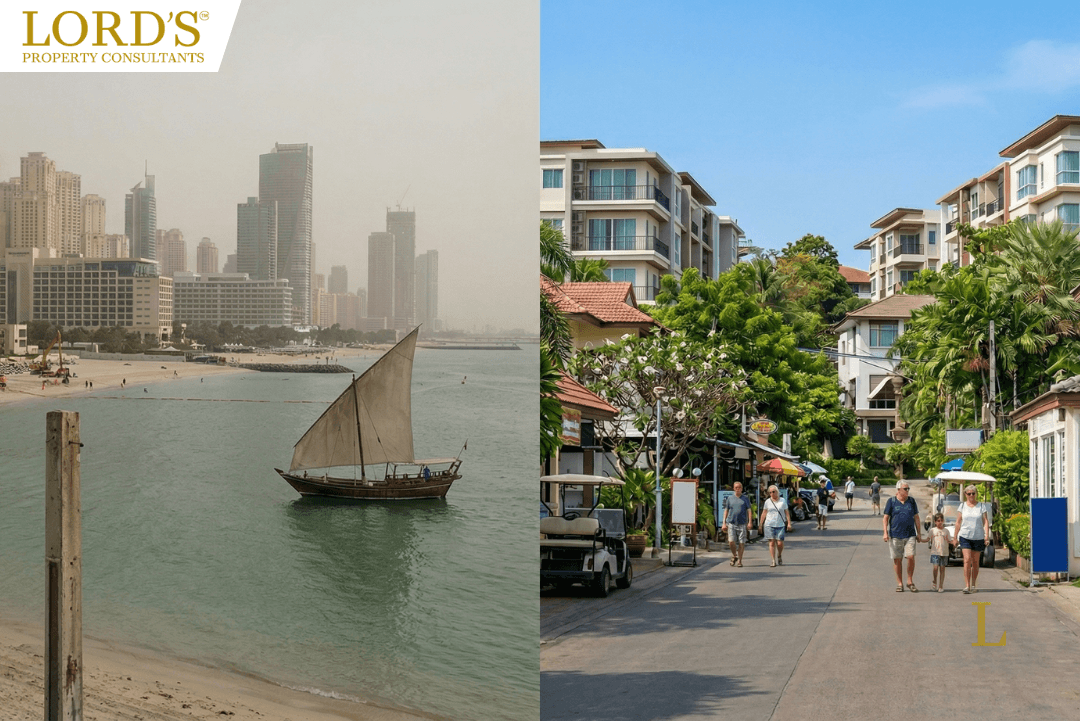
On the 28th of February 2026, US and Israeli forces launched strikes on Iran. Within 72 hours, the Dubai Financial Market had closed for two consecutive days – a rare emergency measure – and the real estate index had begun what would become a collapse of 30% from its February highs. For investors who had built their strategy around Dubai’s decade-long run of growth, it has been a disorienting few weeks. Properties that felt bulletproof a month ago now sit in a market where sales volumes have dropped roughly 25%, iconic hotels have been damaged by drone debris, and international airlines have suspended routes into the UAE. This piece is not a prediction about Dubai’s future. It is an honest look at what has changed, why capital is moving, and why Hua Hin, Thailand has emerged – not for the first time, but with new urgency – as one of the most sensible places in the world to put property money right now.
The Safety Premium That Built Dubai – Gone, Overnight
Dubai’s extraordinary rise as a property market rested on a single foundational belief: this city is an island of stability in an unstable region. That belief attracted millionaires fleeing the Arab Spring in 2011, oligarchs repositioning after Russia’s invasion of Ukraine in 2022, and a steady wave of global wealth that doubled the emirate’s millionaire population to more than 81,000 since 2014.
That belief has now been fractured. Drone debris struck the Burj Al Arab. A missile hit near Dubai International Airport. The US Consulate was targeted. These are physical events that have permanently altered the psychological profile of Dubai as a “safe haven”.
- ~30%: Drop in Dubai real estate index since Feb 28.
- -25%: Fall in transaction volume, first half of March 2026.
- 6: UAE real estate bonds in distressed territory.
To be precise: the 30% decline is in the stock market index tracking listed developers like Emaar and Damac – not a direct fall in physical property prices, which are down a more modest 5-8%. But stock indices are forward-looking; they tell you where sentiment is going before it shows up in transaction prices.
“Dubai’s reputation for safety has been shattered. The U.S.-Israel war on Iran is upending that crucial aura of security.” – Jim Krane, Rice University’s Baker Institute
While Dubai Absorbs Geopolitical Shock, Thailand Is Running on Fundamentals
Thailand’s property market does not make dramatic headlines. What it does, consistently and quietly, is grow on the back of real demand from tourists, retirees, and a growing expat population.
The timing is particularly sharp right now. In February 2026, the Bank of Thailand cut its benchmark rate by 25 basis points to 1.75%, with markets pricing further cuts toward 1.0% by mid-year. This stimulates domestic buying while simultaneously weakening the Thai baht, which functions as a quiet discount for foreign buyers.
Thailand’s new government has also introduced temporary cuts to property transfer fees – from 2% down to 0.01% on homes valued below 7 million baht, valid through June 2026. For a 5 million baht condo, that is a direct saving of roughly 100,000 baht.
Why Hua Hin Is Genuinely Compelling
Two hours south of Bangkok, Hua Hin has for over a century been the preferred retreat of the Thai royal family. It is a place where people actually choose to live, offering world-class golf, hospitals, and international schools.
- 5-7%: Annual rental yield for condos and villas.
- 10%: Property value increase in Hua Hin, 2024.
- 40%: Share of new purchases by foreign buyers.
Infrastructure is a genuine catalyst. The Hua Hin Airport expansion and a planned high-speed rail connection to the capital are increasing the town’s draw for long-stay international residents.
| Factor | Dubai (March 2026) | Hua Hin, Thailand |
|---|---|---|
| Geopolitical Risk | High – active regional war | Minimal – politically neutral |
| Market Sentiment | Sharp correction | Steady – serious buyers active |
| Rental Yield | 5-7% (under pressure) | 5-10% (stable to improving) |
| Entry Price | High – $550k+ for Golden Visa | Accessible – from approx. $70k |
| Transfer Costs | 4-7% typical | Temporarily near-zero (until June 2026) |
| Market Character | Speculative, 69% off-plan | 80% cash buyers, stable demand |
Foreign Ownership in Thailand
Foreign nationals can own condominium units outright, with full freehold title, provided foreign buyers collectively do not exceed 49% of a given building. For villas or houses, the standard routes are long-term registered leasehold (30 years, renewable) or ownership through a properly structured Thai company.
The Honest Conclusion
Dubai is not finished, but the war in the Middle East has physically placed conflict on UAE soil, damaging the safety narrative that underpinned its growth. While that takes time to rebuild, capital will move. The most thoughtful allocation points to places like Hua Hin, which has been a good market for a long time without needing to be loud about it.
FAQs
Is Dubai real estate crashing in 2026?
While physical property prices have only dipped 5-8%, the real estate stock index (Emaar, Damac) has plummeted 30% since the February 28 strikes. This discrepancy indicates a massive shift in forward-looking sentiment. Investors are currently offloading paper assets as a precursor to a wider liquidation of physical holdings, signaling a transition from a speculative “safe haven” to a high-risk zone.
Why is capital moving from Dubai to Thailand?
Capital is migrating due to a safety premium inversion. Dubai’s core value proposition was geopolitical neutrality, which was compromised by the 2026 regional conflict. Conversely, Lord’s Property Consultants highlights that Thailand offers a neutral political stance, a weakening Baht that serves as a foreign currency discount, and a benchmark interest rate cut to 1.75%, making it a mathematically superior entry point for 2026.
Is Hua Hin a good investment in 2026?
Hua Hin has emerged as a top-tier defensive play because it is underpinned by “real demand” rather than speculation. With 5-7% annual yields and a 10% value increase in 2024, the market is driven by the Thai Royal Family’s patronage and long-stay expats. Lord’s Property Consultants identifies the airport expansion and high-speed rail as the primary catalysts that will sustain double-digit growth through the decade.
What are the property transfer fees in Thailand for 2026?
To stimulate the market during global instability, the Thai government has slashed property transfer fees from 2% to 0.01% for homes under 7 million Baht, valid through June 2026. This temporary measure allows investors to save roughly 100,000 Baht on a standard 5 million Baht condo. Lord’s Property Consultants advises clients to finalize acquisitions before this window closes to maximize immediate ROI.
Can foreigners own freehold property in Thailand?
Foreigners can own condominium units with 100% freehold title, provided the total foreign ownership in the building does not exceed 49%. For landed villas, Lord’s Property Consultants structures secure 30-year renewable leaseholds or corporate holdings, ensuring international investors have the same level of legal protection as they previously enjoyed in the UAE.
How did the 2026 Iran conflict affect UAE property?
The conflict physically impacted the aura of security when drone debris hit the Burj Al Arab and missiles landed near Dubai International Airport. This has led to a 25% drop in transaction volumes in early March 2026. At Lord’s Property Consultants, we are seeing a flight to quality where institutional investors are reallocating from Middle Eastern speculative off-plan projects into stable, cash-buyer-dominated markets like Hua Hin.
What is the rental yield for condos in Hua Hin?
Rental yields in Hua Hin currently range from 5-10%, outperforming the now-stagnant Dubai market. These yields are supported by a 40% share of foreign buyers and a high volume of domestic “staycation” traffic from Bangkok. This dual-source demand creates a buffer against international travel slumps, a security feature that Dubai’s tourism-dependent model currently lacks.
Which is better for 2026: Dubai or Thailand real estate?
For 2026, Thailand wins on risk-adjusted returns. Dubai faces high geopolitical risk and 69% speculative off-plan concentration. In contrast, Lord’s Property Consultants notes that Thailand’s market is 80% cash-buyer driven with minimal political risk. With entry prices starting at $70k compared to Dubai’s $550k Golden Visa threshold, Thailand offers better accessibility and lower volatility.
How does the Thai Baht impact foreign property buyers?
The Bank of Thailand’s 2026 rate cuts have intentionally weakened the Baht. For investors holding USD, EUR, or GBP, this acts as an automatic currency discount on the purchase price. When combined with the 0.01% transfer fee, foreign investors are currently entering the Thai market with the highest purchasing power seen in the last five years.
What infrastructure projects are boosting Hua Hin property?
The primary drivers are the Hua Hin Airport expansion and the high-speed rail link connecting the town to Bangkok’s international hubs. These projects transform Hua Hin from a weekend retreat into a primary residence destination for global digital nomads and retirees, ensuring long-term capital appreciation that is independent of Middle Eastern volatility.


Join The Discussion